Never wondered if your phone could hurt you? Nowadays, it’s impossible to imagine a life without our precious electronics. But would you still be so fond of them if they happened to be carcinogenic? What about electricity? Could the thing that is the foundation of our modern world slowly be killing us?
Electricity is the movement of electrons through a medium. This displacement acts as a source of a varying electric field, which generates a magnetic field. These two fields together form an electromagnetic wave. The propagation of this electromagnetic wave through space is what is called electromagnetic radiation. The mathematical curves, which describe the electric and magnetic fields are sinusoidal. These curves are characterised by their frequency and wavelength.
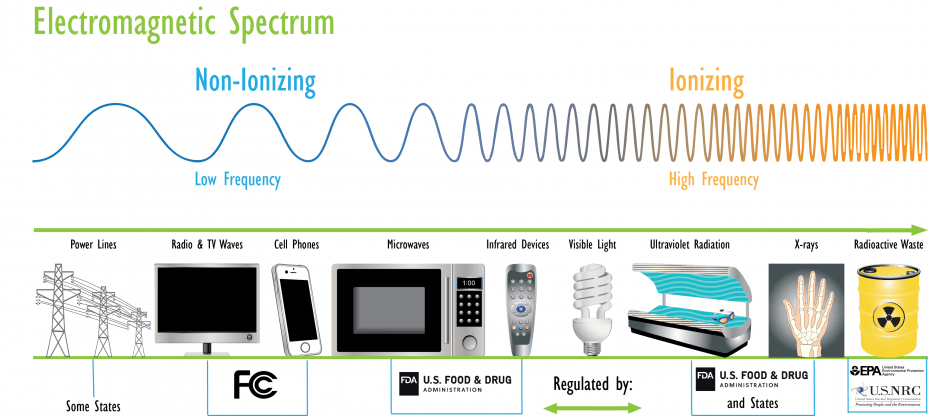
Radiation as a word on its own radiates fear, danger and disaster, but not all radiation is bad. Many types are perfectly harmless, such as: infrared radiation, radio waves, microwaves or even visual light. However, some radiation has enough energy for ionisation, which poses a health risk by damaging tissue and DNA in genes [1].
Humans have always been exposed to natural and general electromagnetic radiation, but since the industrial revolution we have added a lot of it to our daily life and as a result, to our immediate environment. We already know that acute exposure to a high level of radiation causes radiation sickness and can result in death, but what about this weak electromagnetic radiation we are constantly surrounded by?
This question first came to public attention when a 1979 study [2] linked electrical wiring to childhood cancer. In spite of the fact that it did set more research in motion, this particular study was discredited in 2012. Thousands of surveys, reports and scientific studies have been conducted by a wide range of organisations over the last decades [3] [4] [5] [6]. Although some of them are more reliable than others, the World Health Organisation (WHO) officially classified electromagnetic fields (EMF) as possibly carcinogenic to humans [7]. Undoubtedly, this means that there are some hints that EMF might cause cancer, but studies aren’t consistent enough and we can’t prove it.
Unfortunately, the absence of an effect on public health could mean that the radiation is possibly harmful in the long-term because of a yet unknown mechanism. Therefore, the WHO established an international EMF project to keep an eye open for us [8].
References
- Environmental Protection Agency, “Radiation basics,” EPA, 11 June 2019. [Online]. Available: https://www.epa.gov/radiation/radiation-basics. [Accessed 2 November 2019].
- E. L. Nancy Wertheimer, “ELECTRICAL WIRING CONFIGURATIONS AND CHILDHOOD CANCER,” American Journal of Epidemiology, vol. 109, no. 3, pp. 273-284, 1979.
- M. R. S. Vijayalaxmi, “International and National Expert Group Evaluations: Biological/Health Effects of Radiofrequency Fields,” International Journal of Environmental Research and Public Health, vol. 11, pp. 9376-9408, 2014.
- B. L. A. A. K. M. K. J. P. K. J. P. T. J. J. D. A. A. S. a. D. G. Grzegorz Redlarski, “The Influence of Electromagnetic Pollution on Living Organisms: Historical Trends and Forecasting Changes,” Hindawi Publishing Corporation BioMed Research International, vol. 2015, 2015.
- The INTERPHONE Study Group, “Brain tumour risk in relation to mobile telephone use: results of the INTERPHONE international case–control study,” International Journal of Epidemiology, vol. 39, p. 675–694, 2010.
- J. C. T. a. J. A. v. Dijck, “Impact of high electromagnetic field levels on childhood leukemia incidence,” International Journal of Cancer, vol. 131, p. 769–778, 2012.
- World Health Organisation, “Electromagnetic fields (EMF),” WHO, 2019. [Online]. Available: https://www.who.int/peh-emf/en/. [Accessed 2 November 2019].
- –. M. Gledhill, “INTERNATIONAL EMF PROJECT: 22nd International Advisory Committee,” WHO, Avenue Appia, Geneva, Switzerland, 2017.
 Electronics and Health